Carrock Fell Mine
| Location | Grainsgill, near Mungrisdale, Cumbria — 54.6855, -3.0445 (approximate) |
|---|---|
| Commodities | Tungsten, Arsenic, Copper, Lead |
| Type | Metal |
| Worked | 1854–1981 |
| Operators | Carrock Mining Syndicate (1913–1918) |
| Status | Researched |
Overview
Carrock Mine, in Grainsgill on the western flank of Carrock Fell, was the only mine outside Cornwall and Devon ever to produce wolfram (tungsten ore) at scale — worked in short bursts whenever tungsten prices or wartime demand justified it, between 1854 and final closure in 1981.
History
Wolfram mining at Carrock was carried out only spasmodically from 1854, viable only when tungsten prices were at their peak. The first major period of activity followed formation of the Carrock Mining Syndicate in 1913, partly government-financed; almost 14,000 tons of ore were raised, of which roughly 10,116 tons were milled for close to 100 tons of 16% concentrate. Power came from Pelton wheel generators, supplemented by gas engines in dry weather, and concentrates were roasted in a half-ton hand-raked furnace to drive off arsenic. The workforce peaked at around 100 before falling to 25 by late 1918, as government support ended with the Armistice and the market was swamped by released strategic tungsten stockpiles; underground working stopped that year, though some zinc blende washing continued before the mill was dismantled in 1919. Interest revived during the Second World War and the Korean War, when tungsten supplies again looked threatened, but exploratory work in this period produced no ore. After further changes of ownership, the mine reopened in April 1977 and produced around 16,000 tonnes of ore a year until falling wolfram concentrate prices forced its final closure in October 1981.
Geology
Three principal veins — the Smith, Harding and Emerson veins — run roughly west to east across the steep Grainsgill valley, crossing Grainsgill Beck at close to 90 degrees; the surrounding rock is competent enough that most levels needed little timber support, except where they passed through overlying boulder clay.
Workings
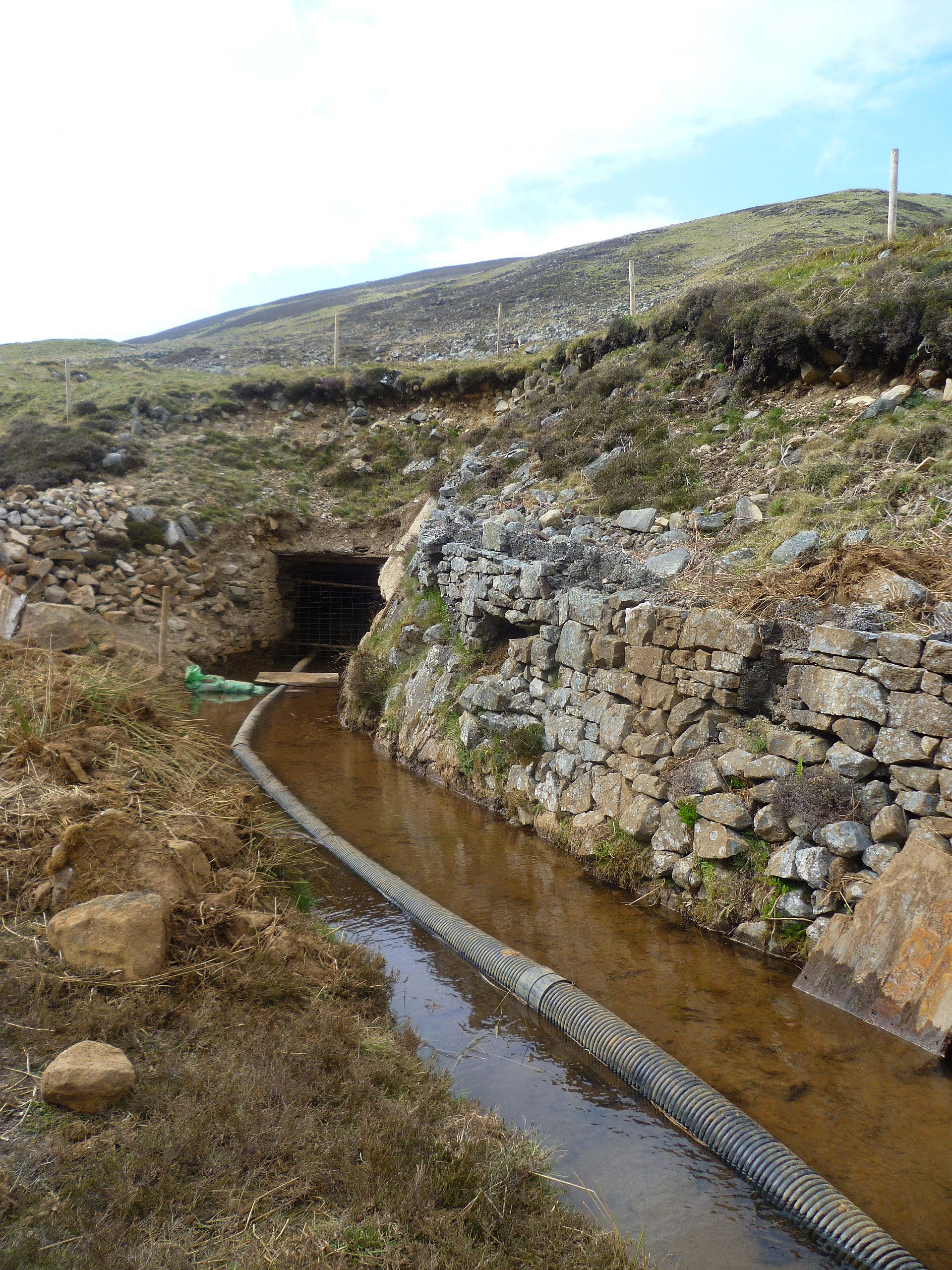
The main adit sits at around 1,115ft elevation; ore from the upper workings descended through internal ore-passes into hoppers at the main adit level for loading into tubs. No workings extended below the main adit level, so the mine never needed pumping or a winding shaft.
What remains
After the lease was abandoned in 1988, the mill and its buildings were completely cleared, and the site — along with the tailings lagoon — was bulldozed and graded back to close to its original contours; the adit portals were destroyed and sealed, though mine drainage water still emerges through the main adit. Only the concrete hopper bases built by the Carrock Mining Syndicate in 1913 now remain on the south side of Grainsgill Beck.
Abandoned workings can be dangerous — unstable ground, uncapped shafts, flooding and bad air are common even where a site looks safe from the surface. This entry describes history and general location only; it is not an access guide.
Recorded claims
Individual factual claims, each attached to the source(s) that support it below. Where sources disagree, both are kept.
- Carrock is, along with Castle-an-Dinas in Cornwall, one of only two mines in Britain where wolfram was the sole ore produced, and the only wolfram-producing mine outside Cornwall and Devon. 1
- The Carrock Mining Syndicate's 1913–18 operation raised almost 14,000 tons of ore, employing around 100 workers at its peak before the workforce fell to 25 by late 1918 as government wartime support was withdrawn. 1
- The mine's final phase, from April 1977, produced around 16,000 tonnes of ore a year until falling wolfram concentrate prices forced closure in October 1981. 1
- Following the 1988 lease abandonment, the mill and its buildings were completely cleared and the site bulldozed back to close to its original contours, leaving only the 1913 concrete hopper bases standing. 1
- A June 2012 report describes the group cutting their underground visit short after encountering bad air in the deepest workings, having explored adits featuring quartz veins and a horseshoe-shaped formation. (uncertain) 2
Photographs & further reading
This page doesn't try to reproduce everything — these are the best original sources found for this mine.
A detailed operating history of Carrock, Britain's only wolfram mine outside Cornwall and Devon.
View sourceAn underground report covering several Carrock Mine adits, turned back before the final level due to bad air.
View sourceImages
Sources
- (secondary) Wolfram — Industrial History of Cumbria
- (observational) Carrock and Old Man Coniston mines, Cumbria - June 2012 — 28DaysLater