Parys Mountain
| Location | Amlwch, Anglesey — 53.3885, -4.3429 (approximate) |
|---|---|
| Commodities | Copper, Gold, Lead, Silver, Zinc |
| Type | Metal |
| Worked | Bronze Age–1904 |
| Maximum depth | worked to at least the 90-fathom level (about 165 m) at Carreg Y Doll lode |
| Operators | Parys Mine Company (1774–1811), Mona and Parys Mines Ltd (1899–1904) |
| Status | Researched |
Overview
Parys Mountain, above Amlwch on Anglesey, was worked for copper from the Bronze Age onward, but its defining moment came in 1768, when a huge new lode discovery briefly made it the largest copper mine in the world — copper that went on to sheathe the hulls of Nelson's navy. Substantial ore reserves are thought to remain beneath the old workings today.
History
Sub-surface debris nearly 4,000 years old shows Parys Mountain was mined for copper in the early Bronze Age, and the Romans are thought to have worked parts of the hill for both copper and lead. The mountain took its modern name from Robert Parys, a royal tax collector granted the land — then called Mynydd Trysglwyn — in 1406. By the mid-18th century ownership was split between the Bayly family and William Lewis, and in 1762 the Bayly family leased the whole site. Everything changed on 2 March 1768, when the miner Rolant Puw struck an exceptionally rich lode near the Golden Venture shaft. Thomas Williams, who formed the Parys Mine Company in 1774, built the operation into the largest copper mine in the world through the 1780s, employing around 1,200 people at its peak and earning himself the nickname the "Copper King". Ore was shipped from the newly developed port of Amlwch to the smelters of Swansea, and Parys copper was used to sheathe the hulls of Royal Navy ships, including those of Nelson's fleet. Between 1768 and 1904 the mountain yielded around 3.5 million tons of ore, producing roughly 130,000 tons of copper metal, with output peaking at 16,400 tonnes of ore in 1829 alone. Control passed to Lord Uxbridge of Plas Newydd in 1811, and output declined sharply after Williams's death in 1802; the Mona and Parys Mines Ltd, formed by merger in 1899, ran the operation through its final years. The last precipitation-pond operations ceased in 1904, though the mines continued as a private company into the 1930s on a much reduced, sporadic basis.
Geology
The site sits on a substantial polymetallic ore deposit — modern exploration estimates around 6.5 million tonnes of reserves containing copper, lead, zinc, gold and silver. Underground development over the mine's working life totalled around 20 kilometres of tunnels.
Workings
Workings reached at least the 90-fathom level at the Carreg Y Doll lode. Modern exploration has included a new shaft, the Morris Shaft, sunk in 1988.
Closure
The main mining operation wound down as the ore quality declined through the 19th century, with the last precipitation-pond processing ceasing in 1904; the site continued as a private company working on a much smaller, sporadic scale into the 1930s.
What remains
The site remains under periodic exploration for a possible modern reopening — a 2015 scoping study examined gradual decline access as a development option, and a 2018 study looked further at re-commissioning the site. No mining is currently active.
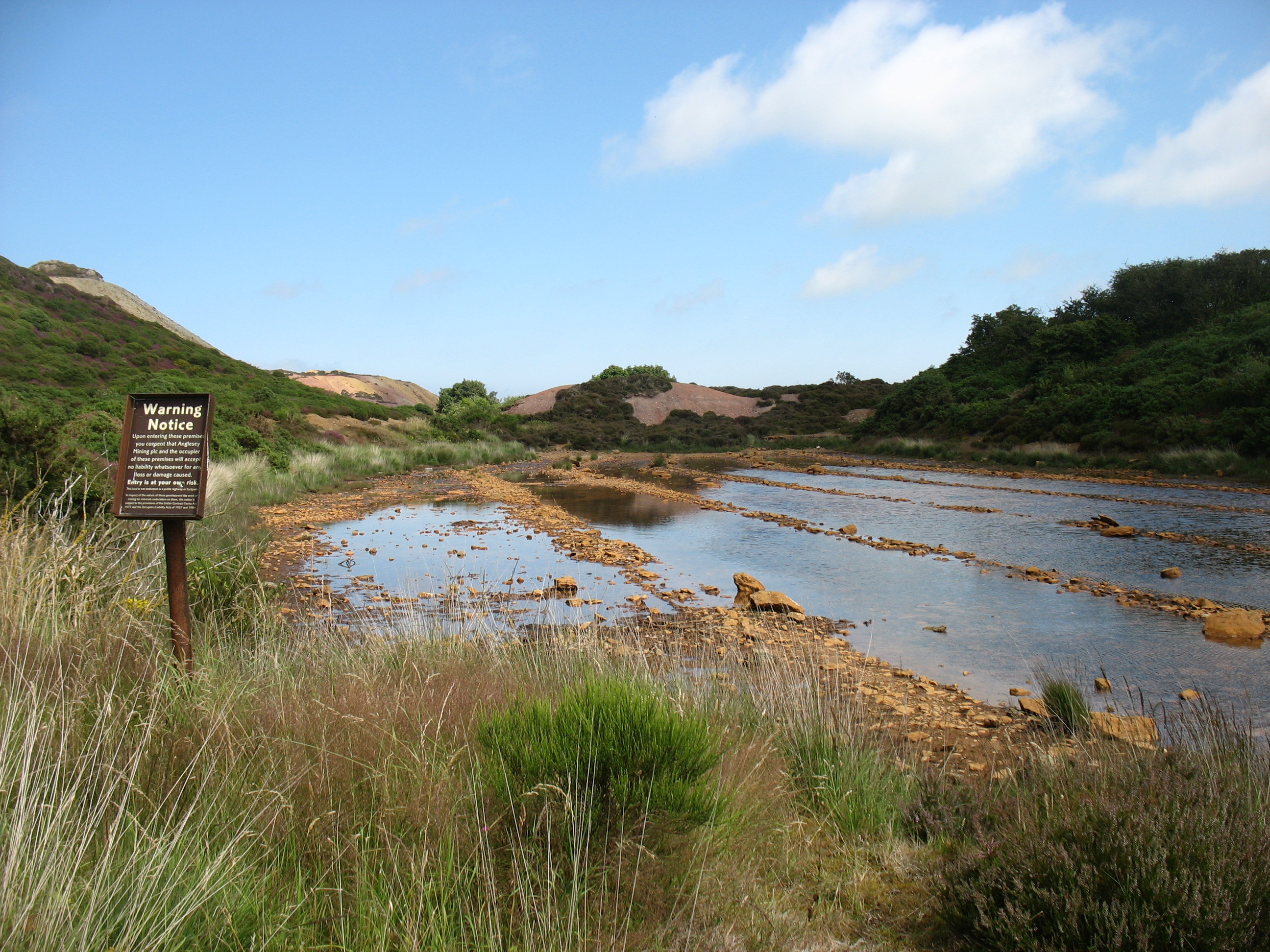
The mountain's distinctive, strikingly coloured landscape — a product of nearly 4,000 years of mineral extraction — survives largely intact, along with extensive opencast workings, spoil, and processing remains.
Redevelopment
No major redevelopment has taken place; the site remains a candidate for a future modern mining operation rather than having been repurposed for another use.
Abandoned workings can be dangerous — unstable ground, uncapped shafts, flooding and bad air are common even where a site looks safe from the surface. This entry describes history and general location only; it is not an access guide.
Recorded claims
Individual factual claims, each attached to the source(s) that support it below. Where sources disagree, both are kept.
- Between 1768 and 1904 Parys Mountain yielded around 3.5 million tons of ore, producing roughly 130,000 tons of copper metal. 1
- Copper from Parys Mountain was used to sheathe the hulls of Royal Navy ships, reportedly including vessels of Nelson's fleet. (uncertain) 1
Photographs & further reading
This page doesn't try to reproduce everything — these are the best original sources found for this mine.
A specialist local group researching and exploring the mountain's underground workings.
View sourceFurther freely-licensed photographs of the mountain's distinctive coloured landscape and workings.
View sourceImages
Sources
- (secondary) History — Grwp Tanddaearol PARYS Underground Group — Grwp Tanddaearol PARYS Underground Group
- (primary) Parys Mountain Copper Mines, Amlwch — Coflein (RCAHMW)