Wanlockhead
| Location | Wanlockhead, Dumfries and Galloway — 55.3969, -3.7769 (approximate) |
|---|---|
| Commodities | Lead, Copper, Gold, Silver, Zinc |
| Type | Metal |
| Worked | 13th century–1934 |
| Maximum depth | beam engine could pump from 28 m below ground |
| Operators | Duke of Buccleuch (Wanlockhead) (1680–?) |
| Status | Researched |
Overview
Wanlockhead, Scotland's highest village, grew up entirely around lead mining in the Lowther Hills — home to some 70 lead veins, alongside notable zinc, copper, silver and, famously, gold. Together with neighbouring Leadhills it formed one of Scotland's most important metal-mining districts, and the village survives today around the Museum of Lead Mining.
History
Mineral deposits here were probably first worked by the Romans, and mining resumed from the 13th century, initially by groups of prospectors who camped in the hills each summer to pan for gold, retreating before the onset of winter. Permanent settlement dates to around 1680, when the Duke of Buccleuch built a lead smelting plant and the first all-year cottages for his workers; the Straitsteps mine, one of the district's most important, opened in 1710. A beam engine installed in 1745 could pump water from as deep as 28 metres below ground, opening up previously unworkable ground. The lead industry thrived through the 18th and 19th centuries — 274 men and boys were recorded working the village's mines in 1876 alone — before a steep decline in the early 20th century saw the industry wind down, ending altogether in the 1930s. A narrow-gauge branch of the Leadhills and Wanlockhead Railway served the village from 1901 until closing in 1939.
Geology
The Lowther Hills around Wanlockhead host roughly 70 lead veins, along with less extensive but locally significant deposits of zinc, copper, silver and gold — the gold notably pure, at up to 22.8 carats, and reportedly used in making the Scottish Crown.
Workings
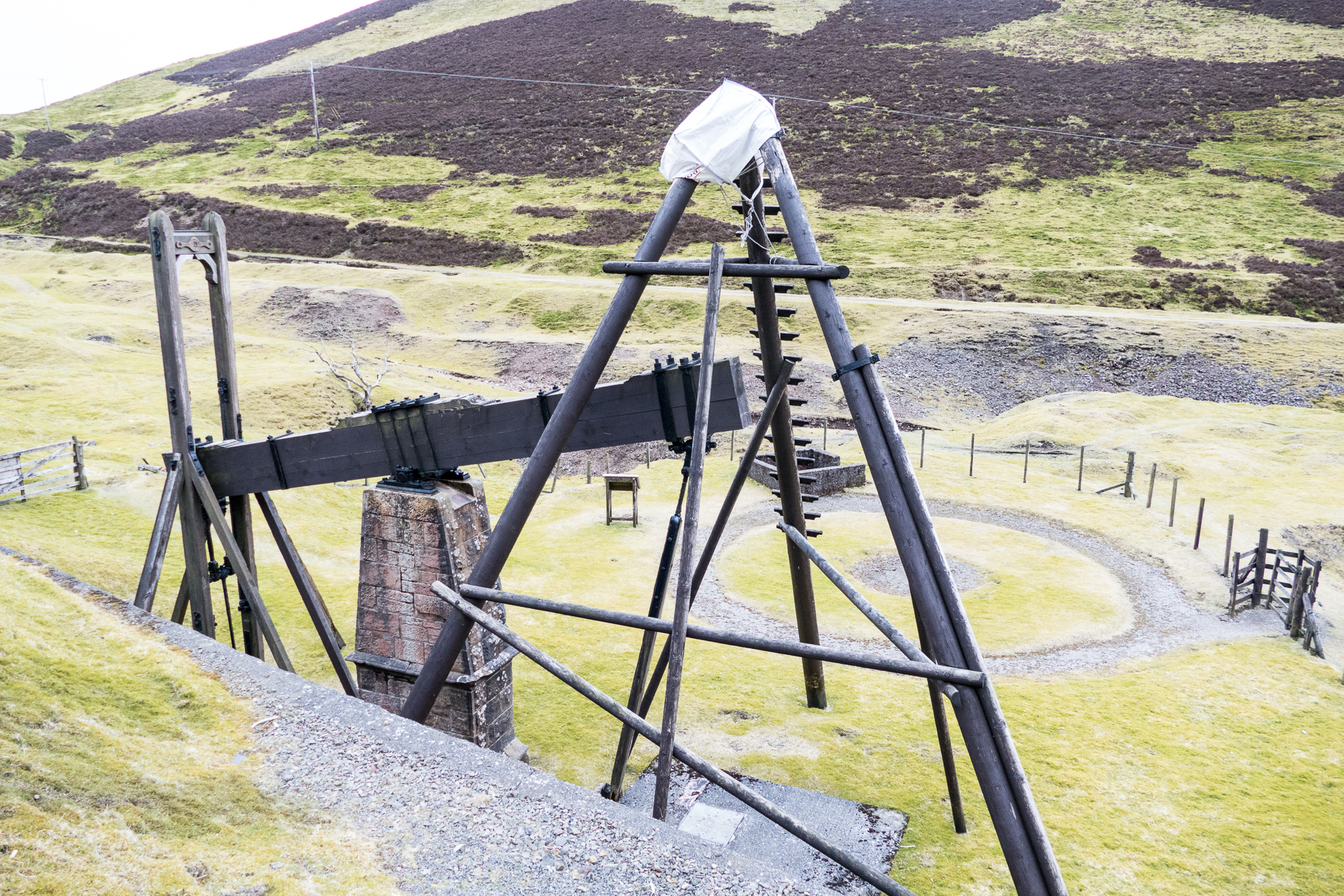
Early working relied on manual digging and gold-panning in local streams. The 1745 beam engine was a major technical advance, able to pump water from 28 m below ground and so extend workable depths well beyond what earlier methods allowed.
Closure
The lead-mining industry declined sharply from the early 20th century and had ceased altogether by the 1930s; some secondary sources instead describe mining continuing into the 1950s, which may reflect confusion with the neighbouring Leadhills district.
What remains
The village survives around the Museum of Lead Mining, and the 1745 beam engine is preserved as a scheduled Historic Scotland monument, with a working model displayed in the museum.
Surviving structures include the beam engine, remains of the Straitsteps and other mine workings, and 18th-century industrial equipment and cottages within the village.
Redevelopment
The Museum of Lead Mining operates on the site, with mine tours and preserved 18th- and 19th-century mining equipment forming the village's main visitor attraction today.
Abandoned workings can be dangerous — unstable ground, uncapped shafts, flooding and bad air are common even where a site looks safe from the surface. This entry describes history and general location only; it is not an access guide.
Recorded claims
Individual factual claims, each attached to the source(s) that support it below. Where sources disagree, both are kept.
- Lead mining at Wanlockhead is generally described as having ceased altogether by the end of the 1930s; at least one source instead states mining finished in the 1950s. (disputed) 1
- Gold from Wanlockhead, reportedly up to 22.8 carats pure, was said to have been used in making the Scottish Crown. (uncertain) 1
Photographs & further reading
This page doesn't try to reproduce everything — these are the best original sources found for this mine.
Scotland's only lead-mining museum, on the site of the historic workings, with mine tours and a beam-engine display.
View sourceFurther freely-licensed photographs of the beam engine and surviving mine workings.
View sourceImages
Sources
- (secondary) Wanlockhead — Wikipedia
- (primary) Museum of Lead Mining — Museum of Lead Mining