Wheal Coates
| Location | St Agnes, Cornwall — 50.3040, -5.2320 (approximate) |
|---|---|
| Commodities | Tin, Copper |
| Type | Metal |
| Worked | 1802–1914 |
| Maximum depth | 600 ft (183 m) at the Towanroath shaft |
| Status | Researched |
Overview
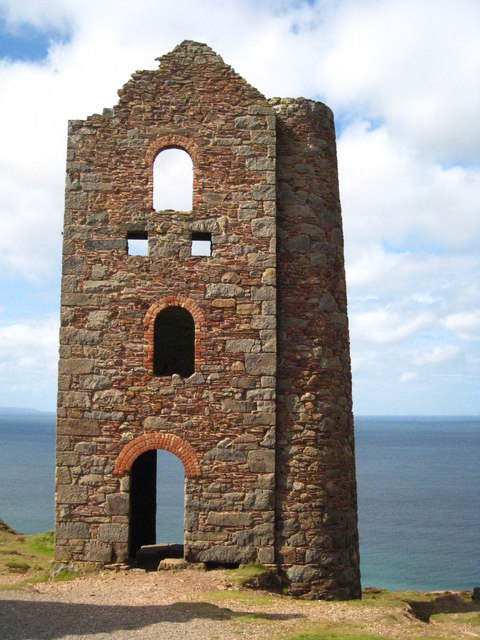
Wheal Coates, on the cliffs near St Agnes, is one of Cornwall's most photographed mining sites — its clifftop Towanroath engine house is an emblem of the Cornwall and West Devon Mining Landscape World Heritage Site. A relatively modest tin producer in its own day, it's now preserved and maintained by the National Trust.
History
Some mining activity is recorded at the site as early as 1692, but the mine in its better-known form opened in 1802, once steam engines became available to pump water out of the shafts, and came into full production by 1815. At its peak the mine employed around 140 people. It was sold in 1844 and subsequently allowed to flood, before reopening under new ownership in 1872 — the year the surviving Towanroath engine house was built to pump water from the 600 ft Towanroath shaft. Falling tin prices closed the mine in 1889. A further attempt in 1906 tried working both tin and copper, and the mine saw a final, sporadic period of activity between 1911 and 1913 before closing permanently in 1914.
Geology
Wheal Coates worked tin-bearing lodes on the north Cornish coast near St Agnes, part of the wider St Agnes Mining District; some workings extended some distance out under the sea.
Workings
Ore was raised and processed using steam power from 1802 onward. Surviving structures — the Towanroath pumping engine house (1872), and separate winding ("whim") and stamping engine houses of similar date — reflect the site's mid-to-late 19th century layout, when tin ore reportedly yielded around 20 lb of tin per ton at one period of working.
Closure
The mine closed permanently in 1914 after a final, sporadic period of reworking between 1911 and 1913 failed to revive its fortunes; production over its history is generally described as sporadic and not especially successful compared to Cornwall's larger mines.
What remains
The site was stabilised and preserved in 1986 and is now maintained by the National Trust. All the surviving structures were Grade II listed on 31 October 1988, and the site forms part of the Cornwall and West Devon Mining Landscape UNESCO World Heritage Site.
Surviving structures include the Towanroath pumping engine house, the Old Whim and New Whim engine houses, a Stamps House, a calciner (1910–1913) and a chimney.
Redevelopment
Managed by the National Trust as a heritage and access site; no other redevelopment has taken place.
Abandoned workings can be dangerous — unstable ground, uncapped shafts, flooding and bad air are common even where a site looks safe from the surface. This entry describes history and general location only; it is not an access guide.
Recorded claims
Individual factual claims, each attached to the source(s) that support it below. Where sources disagree, both are kept.
- All surviving structures at Wheal Coates were Grade II listed on 31 October 1988, and the site forms part of the Cornwall and West Devon Mining Landscape World Heritage Site. 1
- The mine closed in 1889 on falling tin prices, reopened only sporadically between 1911 and 1913, and closed permanently in 1914. 1
Photographs & further reading
This page doesn't try to reproduce everything — these are the best original sources found for this mine.
The site's owner and manager's own account of its history and conservation.
View sourceFurther freely-licensed photographs of the Towanroath engine house and surrounding coastline.
View sourceImages
Sources
- (secondary) Wheal Coates — Wikipedia
- (secondary) Wheal Coates history — National Trust